
On a pair of skates, the wheel is the only part in contact with the ground. It is also the part you replace most often, and yet the one you think about least. The wrong diameter and you lose acceleration; a compound unsuited to your surface and you slide on your edges. Here is how to choose without getting it wrong.
Diameter: 68, 72, 76 or 80 mm?
Diameter governs two opposing things: quickness and top speed. The smaller the wheel, the quicker it is to get moving and the lower the skate sits, so the more stable it is. The larger it is, the better it holds its speed once moving.
- 68 and 72 mm — the junior sizes. Low centre of gravity, a very manoeuvrable skate, less effort on every push. This is what a young player building their skating technique needs.
- 76 and 80 mm — the adult sizes, by far the most common in roller hockey. 76 mm favours changes of direction and short bursts, 80 mm favours speed over long straight-line efforts.
Before ordering, check above all what your chassis accepts: a frame built for 76 mm will not take 80 mm. Many hockey skates use a hi-lo setup, with two smaller wheels at the front and two larger at the back: the stance is then tilted slightly forward, which helps the push. In that case you need two different diameters, not one.
The compound: this is what makes the difference
Diameter is something you see; hardness is something you feel. A soft compound grips more, absorbs bumps better and gives you confidence on your edges; it wears faster in return. A hard compound lasts longer but slides on smooth surfaces.
In roller hockey indoor, and particularly on surfaces of the Stilmattype, the floor is smooth and even: this is soft-compound territory. That is why all our wheels are formulated soft, in Extra Soft or in X-Soft, rather than in the mid-range hardnesses designed for tarmac.
If you play outdoors, on an abrasive, uneven surface, the reasoning reverses: you need a harder compound, even at the cost of some grip.
A full set, not a single wheel
Wheels wear together, and above all asymmetrically: the inner edge always goes first, because that is the edge taking the push. Replacing a single wheel on an already worn set creates an imbalance you feel straight away on the first stride.
- Change your wheels as a full set — count four wheels per skate on a standard chassis.
- Practise a regular rotation : swap the wheels between front and back, and flip them over to wear the second edge. You easily gain a third more life.
- Change them when the profile goes flat or conical, without waiting for the hub to show through.
Don't forget the bearings
A new wheel fitted on tired bearings is pointless: it is the bearing that determines how freely you roll and how well you hold your speed. The standard in roller hockey is the 608, at two bearings per wheel. Our Black Oxy Pro bearings are stainless steel with a black oxidation treatment, built to hold up to match tempo. Take the chance, while changing wheels, to clean them — or to replace them if they drag.
Which Snipe wheel for which player?
| Model | Diameters | Compound | For whom |
|---|---|---|---|
| Snipe Junior | 68 and 72 mm | Extra Soft | Young players: reassuring grip, a low skate, progress made in confidence |
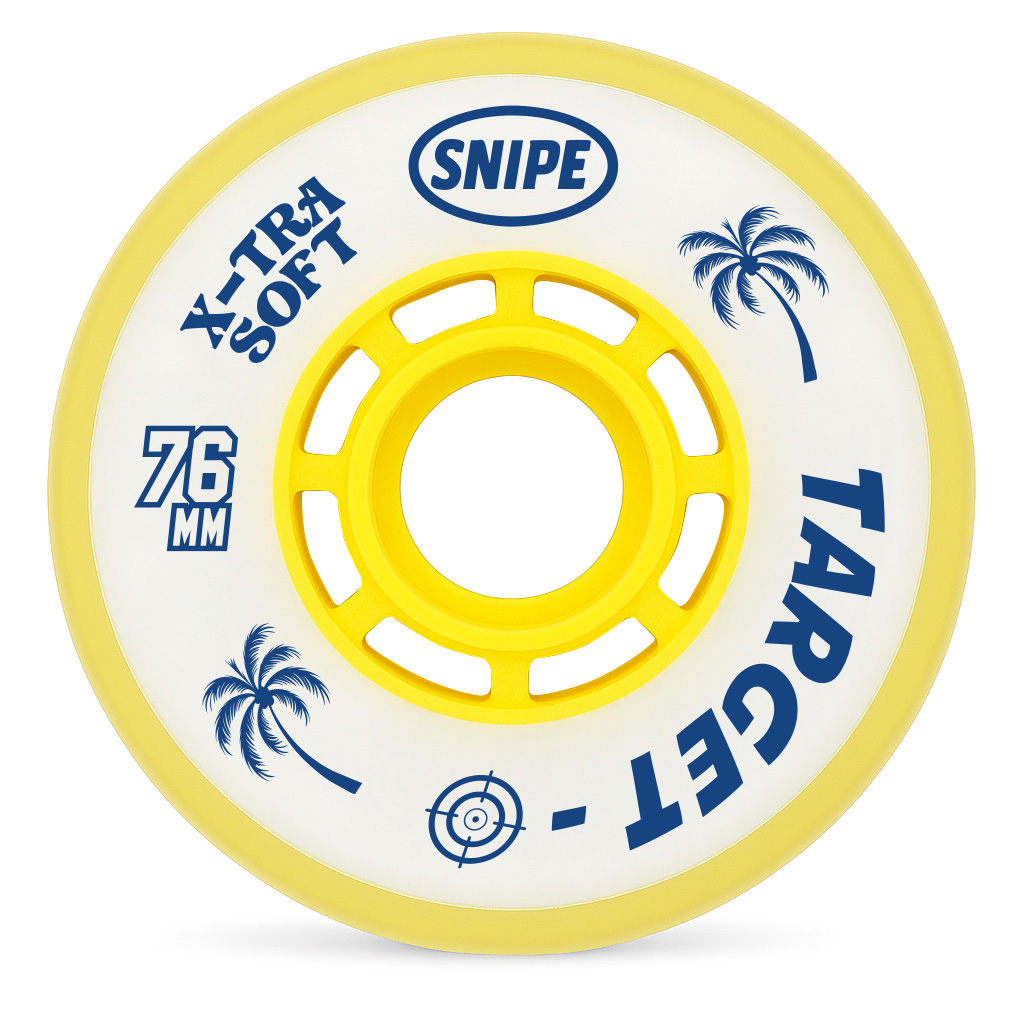
| Snipe Target | 76 and 80 mm | Extra Soft | The versatile adult choice: a balance of grip, speed and longevity |
| Snipe Power Puff | 76 and 80 mm | X-Soft | Players after maximum grip on their edges — and unapologetic pink |
In short
Start from the chassis to set the diameter, from the surface to choose the compound, and always change as a full set, bearings included. On a smooth indoor floor, a soft compound in 76 or 80 mm covers the vast majority of needs; 68 and 72 mm are for juniors.
All our wheels are made and sold factory-direct, with no middleman. See the roller hockey wheels.